Mosaic
The Heart Project
Let's get to the project where I left my heart: Mosaic.
It was easy to understand the needs having two psychologists in the family.
You can find the Figma prototype below, so you can explore the entire experience:
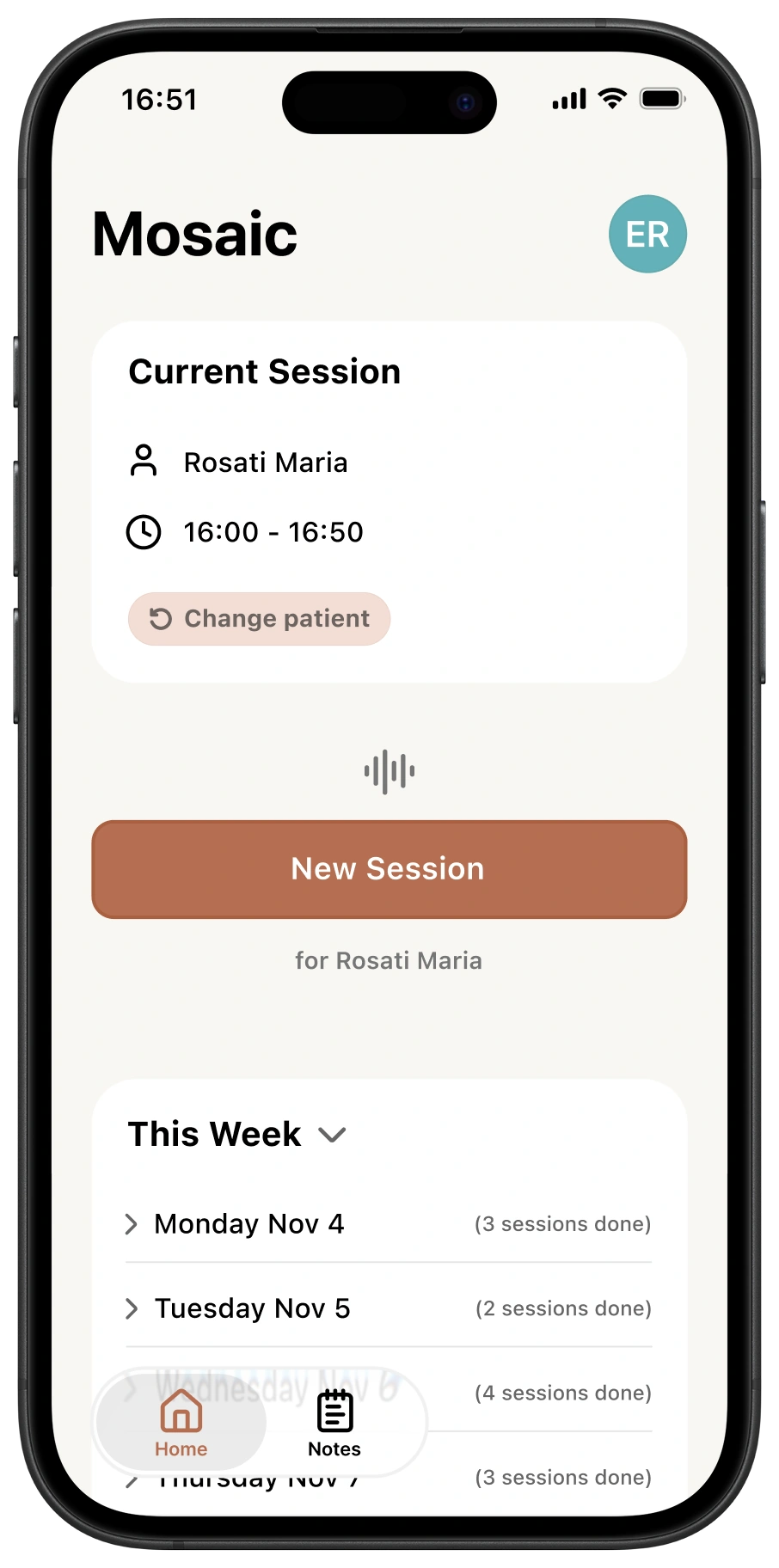
Interactive Prototype
Explore all screens and flows of the app in the complete Figma prototype.
→ Open Figma Prototype
I really want to emphasize that this is not a tool designed to replace the therapist's active listening process. The goal, on the contrary, is to integrate into the current workflow. The ideal process involves the therapist taking their usual notes, on paper or device, and then "dumping" to Mosaic as spontaneously as possible what happened during the session: the AI will take care of structuring and writing it clearly. This would ensure considerable organization and save time at home recomposing the various pieces, because Mosaic does it for you. Additionally, it helps optimize the time between sessions: instead of finding yourself with a few scattered words in a notebook and having to reconstruct the thread of events later, or even worse at home, you can immediately capture what happened and then, while preparing for the next patient, take a quick look at their overview to rapidly refresh your memory. This can become a true new way of working, more fluid and sustainable.
Mosaic does not provide any advice, not even in the Full Analysis. The choice of therapeutic direction will always and only remain in the therapist's hands. I absolutely do not support replacement tools, like tools that listen to meetings or similar and act as a "second brain". We must continue to trust our abilities, otherwise we risk them atrophying in exchange for an initial immediate gain.
Lightweight Liquid Glass and Accessibility:
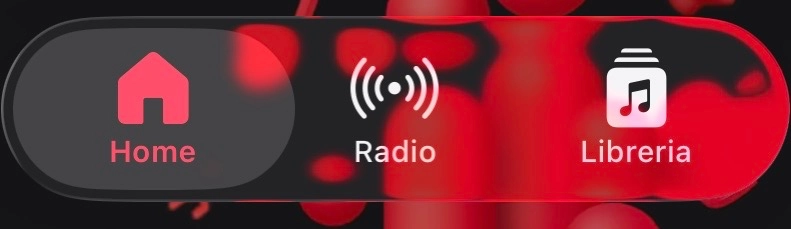
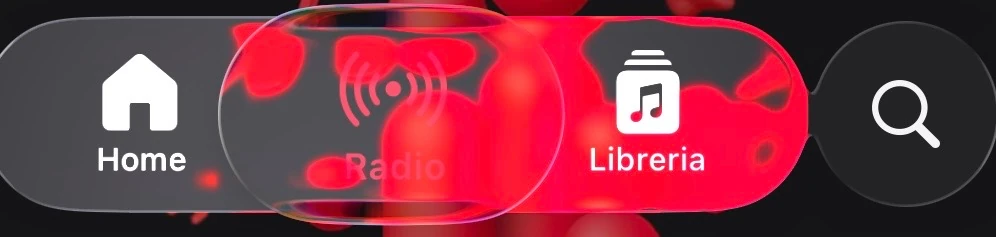
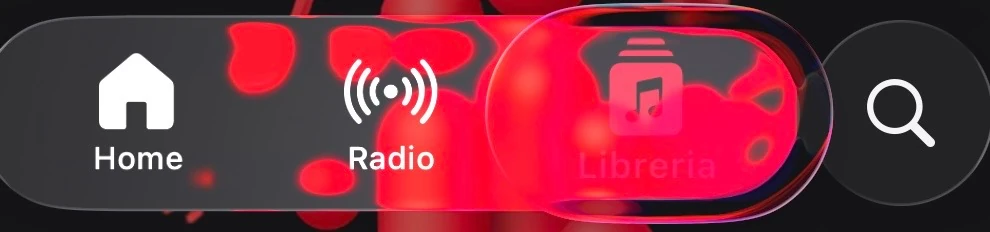
I used a very light Liquid Glass effect. As much as I'm among the people who like it aesthetically, I believe it makes important compromises with visual accessibility.
Here's how Apple used the tab bar in the Music app. I want to clarify that in most iOS applications the effect is not tone-on-tone like in this example:
And how I decided to use it very lightly in Mosaic:
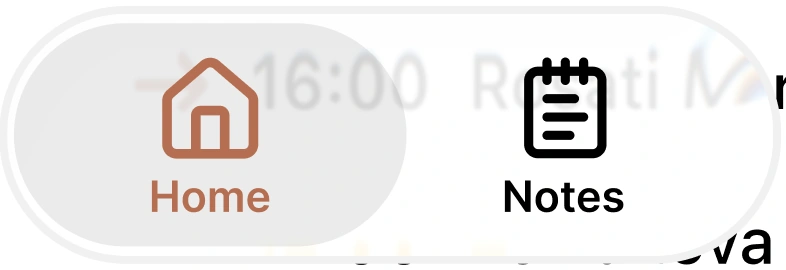
Starting with iOS 26.1, Apple still allows users to disable it in the settings and return to the standard blur effect. Unfortunately, as we learned in the Google course, this isn’t the best approach: complying with accessibility standards doesn’t just help a few it benefits everyone. I find it reasonable to make it optional, but even this detail already suggests that something isn’t quite right.
The Philosophy: Reversing Expectations:
Regarding the open source side, I wanted to play with expectations and expected graphics. If you ask someone to imagine an open source app of this kind, they'll imagine un-"Apple" graphics, complexity, and consequent difficulty of use.
If instead we asked to imagine an app that has a subscription business model of over 30 euros per month, integrated AI, and all these premium features, one would expect exactly Mosaic's graphics.
So I opted for an iOS style, albeit reinterpreted in some aspects, with absolute simplicity as the main priority. All of this, however, completely Open Source.
It’s incredible how a project like this is already truly feasible today by using locally running models such as Microsoft Phi-4 Mini.
Let me explain:
I should note that, since I’m not a backend developer, I might be mistaken, but after several rounds of research I found that Phi-4 Mini would be the ideal candidate for this kind of task. It delivers excellent output quickly and the only drawback is its size over 7GB but for a therapist who cares about privacy, this isn’t a problem.
For phones with hardware weaker than an iPhone 15 Pro, lighter models such as Phi-3 Mini or Llama 3.2 3B could be used, and they weigh only around 2GB.
As for transcription, fortunately there’s OpenAI Whisper Base: it’s about 140MB, open-source, and provides excellent transcriptions!